Rob’s scrapbook about Jessica
Missing YouRob’s scrapbook about Jessica is a hand-assembled record of Jessica Mastriani’s public history and private images, and its discovery turns a collection of clippings into a disclosure about Rob Wilkins’s enduring attachment. Roughly made but sustained over time, the album gathers Jessica’s story from her first local newspaper appearance through later national coverage, ending with news of her Juilliard School scholarship. Rob ultimately confirms that he kept it because he could not stop thinking about her after they parted ways.
Discovery and Physical Form
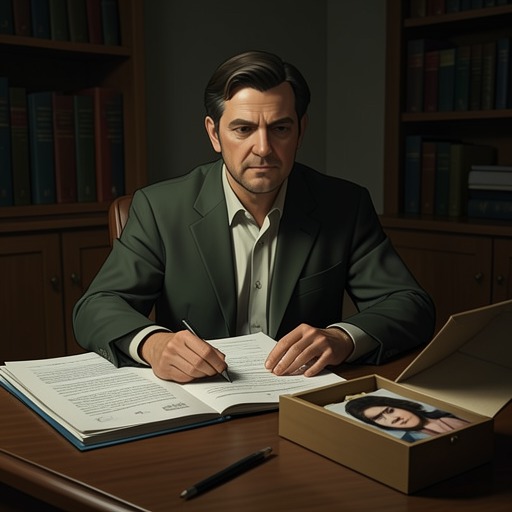
Jessica finds the scrapbook by accident in Hannah Wilkins’s room. As she leaves, her foot catches on something under the detritus on the floor; a paper bearing her name protrudes from a green leather album with gold-embossed trim. The volume is heavy, and loose newspaper clippings spill from it, apparently shaken free by rough handling. Jessica suspects that Hannah had thrown the album across the room in anger. The object first presents itself not as a keepsake offered willingly, but as something displaced, damaged, and unexpectedly exposed.
Its workmanship reflects neither professional craft nor careful arrangement. The pages are numerous, but the clippings have been messily inserted and sloppily glued; duct tape appears among the materials used to hold them in place. Jessica reads this untidy construction as characteristic of someone without scrapbooking experience or much interest in neatness. Yet the album’s disorder contrasts with the persistence required to assemble and keep it: its contents span years of Jessica’s life, and the roughness of its making does not make the record incidental.
A Record of Jessica’s Public Life
The clippings proceed broadly in chronological order. They begin with the first story about Jessica in the local paper and continue to a New York Times article, published after the start of the War on Terror, about unorthodox government methods for combating terrorism. The collection therefore tracks her from local news into national coverage, placing very different phases of her public identity within the same binding. A People magazine piece about Jessica and her family is also included, although Jessica had refused to participate in it.
The album is not exclusively a press archive. It contains photographs, some familiar to Jessica: snapshots Rob’s mother took of them at Thanksgiving dinner, and a picture of Jessica and Ruth together on Santa’s lap at the mall, laughing. Jessica knows she did not give Rob that latter photograph and supposes he persuaded the photographer to sell him a copy. Other photographs are unfamiliar. One, in black and white and positioned in the center of the book, shows Jessica looking into the distance, apparently unaware that anyone is taking her picture. She cannot identify when or where it was taken, or who took it. That image marks a limit in her knowledge of the album: it records a moment she did not know was being preserved.
At the end is the final piece ever written about Jessica: a hometown newspaper announcement that she had won a scholarship to the Juilliard School. Jessica thinks her mother must have submitted it. Her mother had been especially proud of the scholarship—more proud, Jessica reflects, than of her other accomplishments or of all the children and fugitives from justice she had found. The album’s concluding clipping thus records an achievement that mattered deeply within her family as well as in public life.
What the Album Means to Jessica
Jessica can understand why her mother would keep such a collection: her mother loves her, despite their differences, and has an album of her own. Rob’s copy raises a less straightforward question. Because he appears to have kept it current even after their relationship ended, Jessica recognizes that he continued to think about her; she cannot initially determine whether that persistence signifies love or a trophy-like attachment to dating someone famous. She wonders whether he might have kept it to boast that he had dated “Lightning Girl.”
The album’s omissions complicate that suspicion without settling the question by themselves. Jessica recalls that she wrote Rob letters and e-mails sporadically while overseas, but none of them is in the scrapbook. Those personal communications, she reasons, would have made more obvious bragging material than public clippings if the book were simply a trophy. Their absence leaves her uncertain about what the collection was meant to do: it preserves abundant evidence about Jessica, but not the correspondence that would have documented their relationship from her side.
Rob’s Explanation
Jessica takes the album to Rob in the barn, where he is standing by a sink he installed at the far end of the building. When she approaches with it in her arms, he notices what she is carrying and falls silent, leaning back against the metal basin with his arms folded. Jessica tells him, “I found it in Hannah’s room,” and explains that Hannah had mentioned it before, though Jessica had not believed her. Rob asks why keeping track of what Jessica was doing should seem strange, given that he could not ask her while she was not speaking to him.
Jessica points out that not everything in the album dates from the time they were not speaking. Rob first unfolds his arms and puts his fingers in his pockets, then acknowledges the personal meaning of the collection. He says, “You got me. I tried to get you out of my head—from the day I found out you were so much younger than me, I tried to get you out of my head. But I couldn’t. That book’s the result. I know it’s creepy and weird.” His admission resolves the central uncertainty: the scrapbook is the material result of an unsuccessful effort to forget Jessica, maintained despite their separation and despite the age difference that had prompted him to try.
Jessica answers that she does not think it is creepy. The exchange changes the album from a suspicious object into an acknowledged, if awkward, record of attachment. It does not erase her uncertainty about everything Hannah has said, or tell her what Rob now thinks of her after their years apart. But Rob’s explanation makes clear that the scrapbook’s accumulation was not only a catalogue of public stories: behind the clippings and photographs was his continuing attention to Jessica, rendered visible in a book he had made and kept while she was away.